
Landmark Judgement : principles governing grant of bail, criminal antecedents, disclosure of material facts, and interference with an erroneous bail order.
LEGAL NOTE
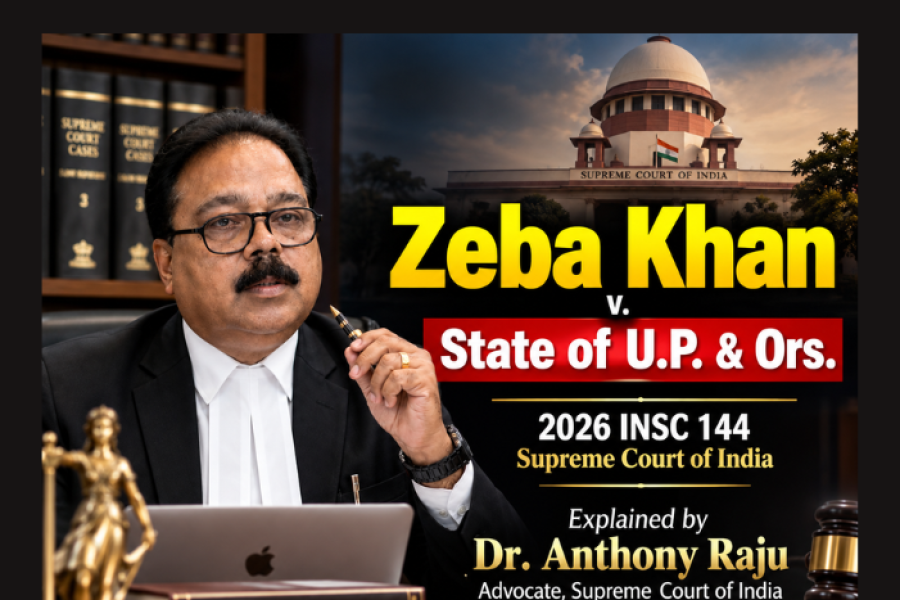
Zeba Khan v. State of U.P. & Ors.
2026 INSC 144 | Supreme Court of India
Explained by Dr. Anthony Raju
Advocate, Supreme Court of India
INTRODUCTION
The judgment of the Hon'ble Supreme Court in Zeba Khan v. State of U.P. & Ors., 2026 INSC 144, is an important decision on the principles governing grant of bail, criminal antecedents, disclosure of material facts, and interference with an erroneous bail order.
The judgment is particularly significant for criminal practitioners because it clarifies the important distinction between cancellation of bail and setting aside an unsustainable order granting bail.
1. BAIL IS A JUDICIAL DISCRETION
Grant of bail involves the exercise of judicial discretion.
Although personal liberty under Article 21 is of fundamental importance, the Court must consider all relevant circumstances, including:
Nature and gravity of the accusation
Specific role of the accused
Prima facie material
Criminal antecedents
Possibility of influencing witnesses
Possibility of tampering with evidence
Possibility of repetition of the offence
Likelihood of absconding
Interests of fair administration of criminal justice
Therefore, bail cannot be granted mechanically.
2. CANCELLATION OF BAIL AND SETTING ASIDE OF BAIL ORDER
This is the most important principle.
Cancellation of Bail means cancellation of a validly granted bail because of subsequent conduct or supervening circumstances, such as threatening witnesses, tampering with evidence, violating bail conditions, absconding or committing another offence.
Setting Aside the Bail Order means that the original order granting bail itself suffers from illegality, perversity, non application of mind, or failure to consider material and relevant factors.
In the latter situation, a Superior Court can interfere with the original bail order even without establishing subsequent misconduct by the accused.
3. DISCLOSURE OF CRIMINAL ANTECEDENTS
A person seeking discretionary relief from a Court must approach the Court with full and candid disclosure of material facts.
The applicant should disclose, wherever relevant:
Previous FIRs
Criminal cases
Sections involved
Present status of cases
Previous bail applications
Orders passed on earlier bail applications
Non Bailable Warrants
Proclamation proceedings
Other material criminal proceedings
The purpose is simple.
The Court must receive a complete and accurate picture before exercising its discretion.
4. SUPPRESSION OF MATERIAL FACTS
Suppression becomes particularly serious where the undisclosed fact is material to the decision on bail.
For example, if an applicant claims that there are no criminal antecedents while material criminal proceedings are pending and such information could influence the Court's assessment of bail, the Court may consider the suppression seriously.
However, every FIR cannot automatically be treated as proof of guilt.
An FIR is not a conviction.
The Court must assess the nature, status, relevance and circumstances of each antecedent.
5. LESSON FOR DEFENCE COUNSEL
Before filing a bail application, counsel should carefully verify:
FIR
Criminal Antecedents
Previous Bail Applications
Bail Rejection Orders
Non Bailable Warrants
Proclamation Proceedings
Trial Status
Custody Status
A complete and truthful disclosure protects both the litigant and the integrity of the proceedings.
6. LESSON FOR PROSECUTION AND COMPLAINANT
Where a bail order has been passed without consideration of material circumstances, the challenge should not be presented merely as:
The accused has violated bail.
The proper question may instead be:
Was the original order granting bail itself legally sustainable?
If relevant material was ignored or discretion was exercised perversely, the Superior Court can examine the legality and propriety of the original order.
7. IMPORTANCE FOR POCSO CASES
Although Zeba Khan is not a POCSO specific judgment, its general principles concerning bail are relevant while arguing criminal bail matters, including POCSO cases.
In a POCSO bail matter, the Court must additionally consider the applicable statutory provisions and the facts relating to the child, allegations, evidence, accused's role, witness protection and stage of proceedings.
Therefore, Zeba Khan should be used as a general bail jurisprudence authority, along with POCSO specific precedents.
KEY TAKEAWAY
A bail order is not beyond judicial scrutiny merely because bail has already been granted.
If the original bail order is legally unsustainable, perverse, or passed without considering material factors, a Superior Court can interfere.
At the same time:
Criminal antecedent is relevant, but an FIR is not a conviction.
Each case must be judicially assessed on its own facts.
LEGAL AWARENESS NOTE
Explained by:
Dr. Anthony Raju
Advocate, Supreme Court of India
WhatsApp and Legal Helpline: 8588872001
Email: office@humanrightscouncil.in
Disclaimer: This Legal Note is intended solely for legal education and awareness. It should not be treated as case specific legal advice. The application of the judgment depends upon the facts and circumstances of each individual case.
#LegalNote #SupremeCourtIndia #ZebaKhan #Bail #CriminalLaw #BailJurisprudence #CriminalAntecedents #LegalAwareness #POCSO #YoungLawyers #DrAnthonyRaju #simanncorps #drjuneann
================
DR. ANTHONY RAJU
ADVOCATE, SUPREME COURT OF INDIA
CRIMINAL LAW PRACTITIONER | POCSO EXPERT | LEGAL SCHOLAR | AUTHOR | PUBLIC SPEAKER | VISITING LEGAL FACULTY | HUMAN RIGHTS ADVOCATE
Dr. Anthony Raju represents a distinctive blend of courtroom advocacy, criminal-law scholarship, legal education, authorship and human-rights advocacy.
As an Advocate of the Supreme Court of India, he is associated with complex and sensitive criminal litigation, particularly matters involving POCSO, sexual offences, serious crimes, personal liberty, constitutional safeguards and human rights.
His professional engagement extends across POCSO cases, rape and sexual-offence matters, bail and anticipatory bail, criminal appeals, suspension of sentence, dowry death and 498A matters, murder and other serious criminal cases, CBI, ED, NIA and PMLA matters, FIR quashing, criminal writs, constitutional remedies, jail reforms and prisoners' rights.
THE CRIMINAL LAW APPROACH
Serious criminal litigation demands far more than an argument in court.
It demands the ability to examine every component of the prosecution case.
FACTS
What is alleged, what is established and what remains to be proved.
EVIDENCE
Oral, documentary, medical, forensic, electronic and scientific evidence must be examined with precision.
WITNESSES
Credibility, consistency, reliability, contradictions, omissions and material improvements require careful scrutiny.
CROSS-EXAMINATION
A carefully structured cross-examination can test the credibility of witnesses, expose inconsistencies and place material facts before the Court.
MEDICAL AND FORENSIC EVIDENCE
Medical records, DNA evidence, FSL reports and other scientific evidence may become critical components of a serious criminal trial.
INVESTIGATION
The legality, fairness, completeness and reliability of the investigation require close examination.
PROCEDURE
Every relevant statutory and constitutional safeguard must be carefully considered.
LAW AND JURISPRUDENCE
Facts and evidence must ultimately be tested against statutory provisions, constitutional principles and binding judicial precedents.
COURTROOM STRATEGY
FACTS + EVIDENCE + WITNESSES + CROSS-EXAMINATION + PROCEDURE + LAW + JURISPRUDENCE
This integrated approach forms the foundation of serious criminal litigation.
AUTHOR AND LEGAL SCHOLAR
Dr. Anthony Raju has authored numerous articles, books and legal writings on important dimensions of criminal justice and jurisprudence, including criminal jurisprudence, jail and prison reforms, the realities faced by undertrial prisoners, prisoners' rights, human rights and criminal justice administration.
His writings reflect an engagement with criminal law not merely as a profession, but as a field of jurisprudence, constitutional responsibility and social justice.
NATIONAL AND INTERNATIONAL PUBLIC SPEAKER
Dr. Anthony Raju has been recognised on national and international platforms for his contribution as a public speaker and legal voice on criminal law, criminal justice, human rights, prison reforms, constitutional safeguards and contemporary legal issues.
VISITING LEGAL FACULTY
As Visiting Legal Faculty, he brings practical courtroom experience and legal scholarship into the classroom, engaging with law students, young advocates and legal professionals on criminal law, evidence, advocacy, jurisprudence and justice administration.
A CAREER BEYOND THE COURTROOM
COURTROOM ADVOCACY
CRIMINAL JURISPRUDENCE
LEGAL WRITING
AUTHORSHIP
LEGAL EDUCATION
PUBLIC SPEAKING
PRISON REFORMS
HUMAN RIGHTS
CONSTITUTIONAL ADVOCACY
Dr. Anthony Raju's professional journey reflects one continuing commitment:
TO UNDERSTAND THE LAW DEEPLY.
TO EXAMINE THE EVIDENCE FEARLESSLY.
TO QUESTION WHAT MUST BE QUESTIONED.
TO PROTECT THE RIGHTS GUARANTEED BY THE CONSTITUTION.
AND TO ADVOCATE FOR JUSTICE WITH KNOWLEDGE, PREPARATION AND CONVICTION.
DR. ANTHONY RAJU
ADVOCATE, SUPREME COURT OF INDIA
CRIMINAL LAW | POCSO | BAIL | APPEALS | CRIMINAL JURISPRUDENCE | PRISON REFORMS | HUMAN RIGHTS | CONSTITUTIONAL REMEDIES
WhatsApp and Legal Helpline: +91 8588872001
Email: office@humanrightscouncil.in
LEGAL DISCLAIMER
This profile is intended for professional and legal-awareness purposes. No particular case outcome is guaranteed. Every matter depends upon its facts, evidence, applicable law, judicial precedents and determination by the competent Court.
#DrAnthonyRaju #AnthonyRaju #AdvocateSupremeCourt #SupremeCourtAdvocate #CriminalLawExpert #CriminalLawyerIndia #CriminalDefence #POCSOExpert #POCSOLawyer #POCSOAdvocate #CriminalJurisprudence #LegalScholar #LegalAuthor #CriminalJustice #JailReforms #PrisonReforms #UndertrialRights #PrisonersRights #HumanRights #ConstitutionalRights #BailLawyer #CriminalAppeal #LegalEducation #VisitingFaculty #PublicSpeaker #LegalSpeaker #SupremeCourtOfIndia #IndianLaw #RuleOfLaw #Justice #DueProcess #DrAnthonyRajuAdvocate #POCSOCaseExpert #CriminalLitigation #HumanRightsAdvocate #dowrydeath #rape #ED #CBI #NIA #PMLA #NDPS #SCSTCASES #GangsterACT
Dr. Anthony Raju | Advocate, Supreme Court of India | Criminal Law Practitioner | POCSO Expert | Author | Legal Scholar | Public Speaker | Visiting Legal Faculty
Complied by
Dr June Ann
Research Scholar


